Thursday, March 6, 2014

BEWARE: Forwarders beware of Chinese scam

Read this on Bulletin.... Always know who you are dealing with. Do not be tempted by cheap offers :). Drop me inquiry if you need any assistance regarding Import/Export to/from Indonesia. Email: ing.kumala@gmail.com / WhatsApp: +62 813 3888 5228

FORWARDERS BEWARE OF CHINESE SCAM

Independent freight forwarders around Europe are being targeted by a fraudulent scam conducted by fake or unscrupulous Chinese agents. Agents are being urged to ensue all due diligence is undertaken before entering commercial agreements with previously unknown partners.
The industry is used to being hit by hundreds of speculative emails from foreign agents offering cheap ocean rates and, while most of these ill-advised and often unprofessional, a number are used as cover for duping unsuspecting victims.

Several regional freight forwarding associations have brought the increasingly prevalent practice to light and highlighted the methods in which the scam operates.

BIFA (British International Freight Association) warned: "On face value these emails appear to be from independent forwarding companies looking for UK partners, by way of offering cheap ocean rates. The majority may be genuine, but for some, deep down there is criminal intent.
"Once an agreement is in place and business starts, all appears to be normal. This is until the cargo arrives at UK port and no-one has received the original Bill Of Lading. When contacted the Chinese forwarder then demands a large ransom for the release of the original Bill of Lading.

The Dilemma for UK forwarders and their customers is whether to pay, knowing the pain and cost that comes with not having the original documentation.

"BIFA recommends diligence and advises that whilst entering into any form of agreement, with an overseas partner, just asking for a signature or an agency agreement is not good enough."
Releasing the cargo without the original Bill of Lading can lead to major problems and financial penalties and is to be avoided in all circumstances.

Source: Voice of the Independent, Nov 2013, page 3.

How To Avoid Perishable Cargo Claims

How To Avoid Perishable Cargo Claims


While perishable cargo is highly profitable for freight forwarders, it can add additional risks, resulting in ruined cargo and dissatisfied customers. FP Marine Risks Perishable Cargo Claims Experts, Richard Kamppari-Baker offers some advice on the transport of perishable and temperature controlled cargo to minimise costly and time-consuming claims and ruining your business reputation.

The duty of merchants, carrier and freight forwarders is to ensure cargo arrives in the same time, or as close as possible to the condition it was prior to transport. Refrigerated cargo adds many more complications because the minite the cargo arrives into your care, it is already deteriorating and the rate of deteroratin is highly independent on the actions of the carrier, freight forwarder and the merchant.

There are a few obvious checks that can be done to minimise the risks of deterioration.
Pre-trip checking - Ensure the unit is clean and free of odours and the floor channels and drains are clear of debris. Some highly odious products may leave odours within containers from previous voyages. Perishable cargo can be highly susceptible to even the most hadmless of smells. Like worn socks in your gym locker, the smell rarely improves when the doors are shut. Reject any container you consider a problem because this could taint the entire shipment.

Hot stuffing - This is where the reefer has not been properly cooled down to the designated temperature before loading. Reefers are not intended to cool down the goods in the course of transit. They are designed solely to maintain the temperature. After the cooling unit has been stuffed, the restrictive ventilation makes the cargo difficult to cool. Make sure the unit is properly cooled before loading.

Cargo maintenance - Emissions released from some cargo may cause changes to the temperature. Make sure the cargo is correctly packed and stored and the temperature in maintained and properly ventilated prior to loading.

Temperature or controlled atmosphere settings - Check the settings and ventilation. It's amazing how many claims arise because of people making a mistake on the application of Celsius to Fahrenheit or confuse Celsius with Fahrenheit settings. Always double check the settings and make sure the ventilation settings have been set correctly and/or holes are uncovered.

Stowage - Always ensure stows are below load-line limits and not extended beyond T-section of the floor. Naturally merchants will be inclined to stuff as much cargo as possible and poor ventilation will have serious effect on the deterioration rate.

Temperature maintenance is paramount for perishable cargo and if this is properly carried out along with expert guidelines for the cargo then it should arrive in good order unless something happens outside your control.

as featured on Voice, January 2014, page 6-7, by Richard Kamppari-Baker

Monday, June 24, 2013

PPL Network 6th Annual Global Meeting, Bali 26th - 29th May 2013

Holla.... I am back from my Bali trip almost a month ago. Recently attended PPL Network 6th Annual Global Meeting which held in Bali 26th - 29th May 2013 at Pan Pacific Nirwana Resort. This is my second trip since we joined as member of PPL Network. There were over 230 delegates from more than 80 countries attended the meeting.

It got easier for me this year round as I see familiar faces and old friends. The 4 days 3 nights event was fully packed, exhausting, yet fun and fruitful.

The hotel was AWESOME! Ahem... I do forget that I am being sent as a delegate and enjoyed my self a lot here :p. Food was not as great as I expected. Anyway pictures tell a thousand words... enjoy~~


Traditional Bali Dance - Welcoming Dance

 Traditional Music

Our Italian agent that based in Hong Kong - Transalpe (HK) Ltd - Mr.Marco Scarantino 

 
Our good handling agent in Australia - Across The Ocean - Mr.David Aherne. He is very patient with our customer hahaha
 
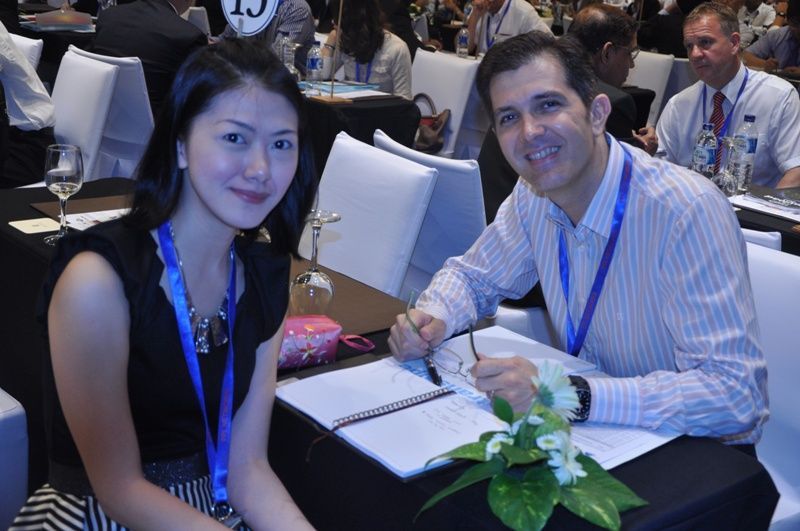
Our 15 minutes "speed dating". Do you spot me?

 Mingle night. L-R: Jeffrey from Trans China, Me and 2 ladies from another Indonesian company. 

Dinner at Merica Restaurant. L-R: Joe Phan from Boston - someone from Hkg - Fred from Boston - Raoul from Spain?

CEO of PPL Network - Mr.Koen Roeyers

With a view like this, no wonder I am enjoying so much
 
All work and no play makes us dull. A memorable night full of laughter, jokes and drinks with fellow friends at Potato head beach bar. Interestingly we are from 7 different countries (USA, Malaysia, Singapore, Hong Kong, Vietnam, China, Indonesia)


From L-R: Jeffrey from Malaysia - Flora from Taiwan - Me - Michael from China

-->>Extended Trip<<--
Me enjoying the sun by the pool with few bottles of heineken and rasberry ice cream :). Life's Good!

See you at PPL Network 7th Meeting at Manila next year!

Ing Kumala
Personal email: ing.kumala@gmail.com
Business email: info@ptkalinda.co.id

Legalizing Service of Shipping Documents By Iraq Embassy

We have been receiving same requests from a couple of freight forwarders in Singapore. As they do not have Iraq embassy in Singapore (lucky us!), they need us to help them in legalising their shipping documents by Iraq Embassy in Jakarta.


First these shipping documents has to be legalize first by Ministry of Foreign Affairs Singapore (MFA) and Secondly from Singapore Malay Chamber of Commerce and Industry. Then you can send the documents to us to process the endorsement from Iraq Embassy. 

1) Sample of Legalization from Ministry of Foreign Affairs Singapore


2) Sample of Legalization from Singapore Malay Chamber of Commerce and Industry


In case you need assistance, feel free to contact us for more details. We know how to handle it.

In your service,
Ing Kumala
Personal email: ing.kumala@gmail.com
Business email: info@ptkalinda.co.id

Tuesday, April 23, 2013

Door to Door service to Jakarta (DDP) - NO HIDDEN CHARGES

International Freight Forwarding - Door to Door (DDP)

Service include freight, import duty, Tax, VAT, import clearance, customs, warehouse, etc until your door in Jakarta area. No hidden charges!

Accepting direct service from: Guangzhou, Shenzhen, Shanghai, Singapore, Hongkong, Korea, Bangkok, Taiwan to Jakarta.

We accept cargo from other countries (example: USA, France, Germany, Italy, Australia, etc)

Please contact below NOW for FREE Consultation

In your service,

Ing Kumala
Personal email: ing.kumala@gmail.com
Business email: info@ptkalinda.co.id

Tuesday, September 4, 2012

Customs Clearance Procedure in Indonesia

http://www.indonesianmission-eu.org/website/netcontent_images/spacer.gif


Import Clearance Procedure
All goods coming into Indonesia must be cleared through Customs and it’s subject to customs duty and other taxes related to import unless specifically exempted from duty by law. Import clearance procedure involves a number of steps as the followings:

- Procedure for entry prior to clearance

Imported goods are not legally entered, until after the arrival of the vessel with the limits of the port of entry. Upon the arrival of the vessel, the Master or His agent is obliged to lodge a General Declaration covering all cargoes and supplies on board to the Customs Service Office not later than the date of the arrival, exclusive of Sundays and Holidays, or any authorized extension, must be furnished with the following information:
  • Name and flag of the vessel and also the name of her master;
  • Country of Origin, place(s) and of loading/departure;
  • Quantity, marking, numbering, and other descriptions of packaging of goods, including weight and volume (cubic content);
  • Kind and quantity of goods which is not packed.
After reporting the vessel’s content to Customs Service Office, the goods can be unloaded at the authorized piers and places (approved landing places), or at any other authorized places subject to the request of the carrier.

2 - Declarant
Goods may be declared by the importer or the customs broker on his behalf. The declarant, in order to obtain clearance of goods for home use or temporary importation must perform the followings:
  • to lodge the importer declaration (PIB), together with the relevant supporting documents such as: commercial invoice, airway bill or B/L, packing list, etc;
  • to pay import duties and taxes;
  • to ensure the accuracy for the particulars in the PIB such as among others: classification or HS/Customs code, custosm value, etc.
In addition the declarant is not only able to, under customs supervision, conduct a preliminary inspection and draw samples of goods before lodging the goods declaration for home use, but also able to obtain advance information from Customs on valuation and/or classification of the goods concerned.
- Import Declaration
Declaration must be made on an import declaration form called “Import Declaration” (PIB) which should be lodged at the Customs Service Office during the office hours.
After submittance of general declaration, the goods are allowed to be deposited in the customs temporary storages (sheds or open spaces) at the port of entry for a maximum period of 2 months, commenced from the date of unloading; however, in Tanjung Priok port of entry, the maximum period of temporary storage is only 1 month. The goods which is not yet cleared within the specified time will be treated as unclaimed goods in which Customs is empowered to remove, destroy, reexport, or sell such goods by auction.
In the case of the unclaimed goods, the importer or his agent is able to, within one-year-of-removal to the Customs Warehouse, lodge the PIB. If the goods is still not claimed by then and if the importer fails to settle expenses incurred for the removal and deposit of the goods, Customs is authorized to sell such goods by auction or otherwise dispose such goods as decided by the Minister of Finance.
The proceeds of the sale are used to cover import duties, taxes, and other expenses. The balance will be returned to the importer if a claim is made within a period of 3 years started from the date of deposit in the Customs Warehouse. If it is not claimed by then, the balance will be appropriated for the State revenue. If the value of the unclaimed goods is not enough to cover the import duties, taxes, and other expenses, those goods, which are not harmful or dangerous, shall be destroyed after three years being taken into custody.

- Documentation 
The PIB among others requires the following information:
  • the name, occupation and address of the declarant;
  • the name of the carrier and her master;
  • country of origin;
  • place where goods are deposited (sheds, open spaces, warehouse, etc);
  • quality, description of goods for the purpose of classification and valuation.
The PIB should be completed with supported  documents such as invoice, bill of lading, insurance papers, packing list, import license for certain kind of goods, etc.

- Examination of Imported Goods
Examination is normally done in the presence of the declarant at legally specified places during office hours. The scope of the examination is normally up to 10%; however, when an offence is detected, a thorough examination will be carried out.
The declarant is responsible for loading and unloading, unpacking, repacking, and providing other facilities needed for the examination of goods. When examination revels and discrepancy, the sample of goods may be extracted for proper classification and assessment of value, duties, and taxes or for any other purposes as may be determined by Customs.

- Appraisement of Dutiable Goods
Customs duties are classified as ad valorem and specific. An ad valorem duty is a percentage which is applied to the dutiable value of the imported goods. Whereas a specific duty is a specified amount per unit of weight, gauge or other measurement of quantity, e.g. Rp.10,000.00 per kilogram under metric system, etc.

- Payment of Duty
Payment of duty and taxes for imported goods shall be done through foreign exchange bank. As for goods brought by passengers coming from abroad which are not classified as commercial goods, the payment of duty and taxes can be done at the Customs  Service Office at the airport. Passengers shall be given a receipt on the spot for duty paid. Any overpayment of duty is returned and underpayment is billed. 

- Release of Goods
In principal imported goods should be released immediately; nevertheless, when an offence is detected, a thorough re-examination will be carried out by Customs. The release of goods will be subject to normal customs procedures. In the case of the value of imported goods can not be assessed promptly due to laboratory analysis requirement, Customs may permit the release of the goods after taking samples or obtaining detailed technical documentations and the importer or declarant has submitted a guarantee to ensure the payment of any additional import duty and taxes might be incurred.

- Goods Damaged, Destroyed or Lost
The Minister of Finance is empowered to remit the whole or any part of duty payable on any imported dutiable goods which by unavoidable accident or lost, damaged or destroyed at any time after their arrival within the limit and before removal from Customs control.

10 - Temporary Importation
To facilitate trade, Customs has provided a facility for temporary importation. This facility allows importers to import temporarily goods without any duty payment under condition, within certain period of time, the goods must be re-exported. Otherwise the goods will be considered as permanently imported or home use and the importers are obliged to pay the duty and taxes incurred as well as fine amounting 100% of customs duty payable.
Goods which are eligible for obtaining temporary admission facility are as follows:
  • Goods  used for seminars and the like;
  •  Goods  used for public entertainment purposes; 
  • Goods used by experts for research, educational, religious, and cultural   purposes, and for making film/movies; 
  • Container used to transport goods repeatedly; 
  • Goods used for samples, models or molds;
  • Articles  used for games;
  • Vehicles or means of transport used by tourists themselves; 
  • Articles  used for oil drilling operation; 
  •  Articles to be repaired, reconditioned, modified, tested or maintained; 
  • Live animals used for publics entertainment, training, breed or the like.
http://www.indonesianmission-eu.org/website/page20379569520030919378945.asp

In your service,
Ing Kumala
Personal email: ing.kumala@gmail.com
Business email: info@ptkalinda.co.id

Thursday, August 30, 2012

Types of Container Specification


General Purpose 20' (click to enlarge)
General-purpose containers come in two sizes: 20 ft and 40 ft. There are two types of general-purpose containers, one is manufactured from steel and the other from aluminum.
• Steel containers have a slightly larger internal cube.
• Aluminum containers have a slightly larger payload.
Both are suitable for most types of cargo.


General Purpose 40' (click to enlarge)


High Cube 40' & 45' (click to enlarge)
High Cube Container
High cube containers are manufactured from steel and aluminum and come in two sizes: 40 ft and 45 ft. High cube containers allow an extra foot in height compared to general-purpose containers. These containers are ideal for light, voluminous cargo or bulky cargo.


Open Top 20' (click to enlarge)
Open Top Container
Open type top containers are manufactured from steel and come in two sizes: 20 ft and 40 ft. They are particularly suitable for bulky cargo such as machinery. These containers are fitted with a PC tarpaulin cover and attachable bows with cable sealing devices. Their doors can be removed to make the stuffing of cargo more convenient.


Open Top 40' (click to enlarge)


Flat Rack 40' (click to enlarge)
Flat Rack Containers
Flat rack containers are manufactured from steel and come in two sizes: 20 ft and 40 ft. They can be collapsible or non-collapsible, with or without walls. They are especially suited to heavy loads or cargo that needs to be loaded from the top or sides such as pipes and machinery.


Flat Rack 20' (click to enlarge)
Life's Good!


In your service,
Ing Kumala
Mobile/WhatsApp: +62 813 3888 5228
Personal email: ing.kumala@gmail.com